Monday, April 02, 2007
BBC NEWS | Asia-Pacific | Tsunami strikes Solomon Islands
BBC NEWS | Asia-Pacific | Tsunami strikes Solomon Islands: "'Basically it was like a really extreme high tide that came very quickly and I reckon that the wave was probably about five metres and just kind of brought the water level up and then just resided really, really quickly,' he told Associated Press."

Tsunami's 5m wall of water | The Daily Telegraph
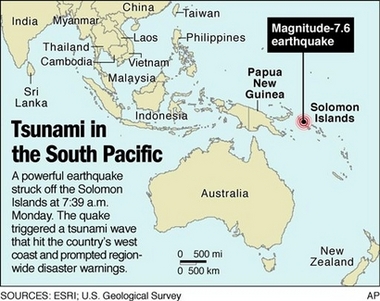
Tsunami's 5m wall of water | The Daily Telegraph: "A wall of water, triggered by a 8.0-magnitude undersea earthquake, swamped Gizo, capital of the western province popular with tourists for its pristine beaches and diving, locals reported.
'The sea is rising up to five metres high... the houses are sunk,'' ferry driver Nixon Silus told Australian radio.
'All the houses on the islands are under water and all the houses are being pulled down and most of their kitchen utensils and all things like that are floating on the sea.''
"
Sunday, April 01, 2007
Oregon Civil Air Patrol prepares for terrorist response training | Local News | kgw.com | News for Oregon and SW Washington
Oregon Civil Air Patrol prepares for terrorist response training | Local News | kgw.com | News for Oregon and SW Washington: "Oregon Civil Air Patrol prepares for terrorist response training
10:07 AM PDT on Sunday, April 1, 2007
ASSOCIATED PRESS
PORTLAND, Ore. -- The Oregon Wing of the Civil Air Patrol is participating in a week-long simulated terrorist training and evaluation exercise that started Friday."
10:07 AM PDT on Sunday, April 1, 2007
ASSOCIATED PRESS
PORTLAND, Ore. -- The Oregon Wing of the Civil Air Patrol is participating in a week-long simulated terrorist training and evaluation exercise that started Friday."
starbulletin.com | News | /2007/04/01/

starbulletin.com | News | /2007/04/01/: "Emergency agencies will test a new technology in an exercise tomorrow focusing on a potential tsunami-generating Big Island earthquake, says Edward Teixeira, state Civil Defense vice director.
Planned as part of Tsunami Awareness Month and coinciding with monthly Civil Defense siren tests, the exercise offers a chance to use some new instruments in the warning system."
Saturday, March 24, 2007
Geophysicist calls for considering all subduction zones as potential tsunami threats
Geophysicist calls for considering all subduction zones as potential tsunami threats: "Geophysicist calls for considering all subduction zones as potential tsunami threats
From our ANI Correspondent
Washington, March 24(ANI): A geophysicist from Rensselaer Polytechnic Institute, Professor Robert McCaffrey has urged the public, and policy makers to consider all subduction-type tectonic boundaries to be 'locked, loaded, and dangerous,' and potential tsunami threats. "
From our ANI Correspondent
Washington, March 24(ANI): A geophysicist from Rensselaer Polytechnic Institute, Professor Robert McCaffrey has urged the public, and policy makers to consider all subduction-type tectonic boundaries to be 'locked, loaded, and dangerous,' and potential tsunami threats. "
Friday, March 23, 2007
BBC NEWS | Science/Nature | Sea floor records ancient Earth

BBC NEWS | Science/Nature | Sea floor records ancient Earth: "'Since the plate tectonic paradigm is the framework in which we interpret all modern-day geology, it is important to know how far back in time it operated,' said Professor Minik Rosing of the University of Copenhagen and one of the authors of the paper."
Friday, March 16, 2007
NewsLocale - CPR Without Mouth-to-Mouth More Effective in Sudden Heart Attack
NewsLocale - CPR Without Mouth-to-Mouth More Effective in Sudden Heart Attack: "CPR Without Mouth-to-Mouth More Effective in Sudden Heart Attack PDF Print E-mail
Written by Therasa Maher
Friday, 16 March 2007
A patient who suffers a sudden heart attack may be better off if the subsequent cardio-pulmonary resuscitation (CPR) efforts do not include mouth-to-mouth ventilations, a new Japanese study suggests. Current guidelines say that CPR must include 30 chest compressions followed by two mouth-to-mouth ventilations."
Written by Therasa Maher
Friday, 16 March 2007
A patient who suffers a sudden heart attack may be better off if the subsequent cardio-pulmonary resuscitation (CPR) efforts do not include mouth-to-mouth ventilations, a new Japanese study suggests. Current guidelines say that CPR must include 30 chest compressions followed by two mouth-to-mouth ventilations."
Tuesday, March 13, 2007
starbulletin.com | News | /2007/03/13/
starbulletin.com | News | /2007/03/13/: "NOAA seeks faster tsunami solutions
The NOAA, celebrating its 200th anniversary, is trying to quicken detection of tsunamis
By Helen Altonn
haltonn@starbulletin.com
Enhancing Hawaii's seismic network to collect better and faster information about tsunami threats is one of the goals this year of the National Oceanic and Atmospheric Administration, says a key official.
It now takes two to three minutes after an earthquake to collect sufficient data to determine if a dangerous tsunami was generated, said Jeff LaDouce, director, National Weather Service Pacific Region.
'We're trying to get the solution for the location and intensity of earthquakes in the quickest time -- in 90 seconds,' LaDouce said in an interview at a recent breakfast meeting launching a yearlong celebration of NOAA's 200th anniversary.
The Pacific Tsunami Warning Center is one of the many functions of NOAA, which manages more than $70 million annually in Hawaii fishery, oceanic, coastal, climatic and atmospheric programs, LaDouce pointed out."
The NOAA, celebrating its 200th anniversary, is trying to quicken detection of tsunamis
By Helen Altonn
haltonn@starbulletin.com
Enhancing Hawaii's seismic network to collect better and faster information about tsunami threats is one of the goals this year of the National Oceanic and Atmospheric Administration, says a key official.
It now takes two to three minutes after an earthquake to collect sufficient data to determine if a dangerous tsunami was generated, said Jeff LaDouce, director, National Weather Service Pacific Region.
'We're trying to get the solution for the location and intensity of earthquakes in the quickest time -- in 90 seconds,' LaDouce said in an interview at a recent breakfast meeting launching a yearlong celebration of NOAA's 200th anniversary.
The Pacific Tsunami Warning Center is one of the many functions of NOAA, which manages more than $70 million annually in Hawaii fishery, oceanic, coastal, climatic and atmospheric programs, LaDouce pointed out."
Tornado Responders Slowed By Cell Phones, First Responders In Alabama Used Cell Phones Instead Of New $18M State Radio Network - CBS News
Tornado Responders Slowed By Cell Phones, First Responders In Alabama Used Cell Phones Instead Of New $18M State Radio Network - CBS News: "(AP) In the chaos after a tornado killed nine people in Enterprise, emergency workers had trouble talking to one another because they tried to use their cell phones instead of the state's $18 million emergency communications upgrade, officials say.
'People were frustrated, but all they had to do was turn on their radios,' state Homeland Security Director Jim Walker told The Associated Press in a recent interview.
"
'People were frustrated, but all they had to do was turn on their radios,' state Homeland Security Director Jim Walker told The Associated Press in a recent interview.
"
Tuesday, March 06, 2007
The Standard - China's Business Newspaper
The Standard - China's Business Newspaper: "The US Geological Survey put the epicenter about 420 kilometers from Singapore. The Indonesian national quake center measured the first quake at 5.8.
A magnitude six earthquake struck the same area two hours later, causing more panic. But Padang is one of the few Indonesian cities where a tsunami warning system is in place."
A magnitude six earthquake struck the same area two hours later, causing more panic. But Padang is one of the few Indonesian cities where a tsunami warning system is in place."
Monday, February 26, 2007
5.4 Quake Hits Off Coast Of Eureka - News
5.4 Quake Hits Off Coast Of Eureka - News: "EUREKA, Calif. -- A 5.4-magnitude earthquake off the coast of Northern California shook parts of Humboldt County on Monday, but authorities said there were no immediate reports of injuries or damage.
The U.S. Geological Survey said the moderate quake at 4:20 a.m. struck about 30 miles off the coast south of Eureka.
The West Coast and Alaska Tsunami Warning Center said no tsunami was generated by the quake."
The U.S. Geological Survey said the moderate quake at 4:20 a.m. struck about 30 miles off the coast south of Eureka.
The West Coast and Alaska Tsunami Warning Center said no tsunami was generated by the quake."
Sunday, February 25, 2007
Nevada Appeal - News
Nevada Appeal - News: "Coming off a ground-breaking Tahoe tsunami research year, scientists are planning for a new season of underwater science, one they hope will pinpoint the date of a past monster wave.
Along the way they will investigate the potential for a tsunami in Tahoe's future, including analyzing the strength and stability of steep rock walls along the lake, which could collapse and cause another huge wave.
Last year, scientists believed they found definitive proof that a huge landslide caused approximately 100-foot waves to wash over what is now Tahoe City, sometime within the last 20,000 years or so."
Along the way they will investigate the potential for a tsunami in Tahoe's future, including analyzing the strength and stability of steep rock walls along the lake, which could collapse and cause another huge wave.
Last year, scientists believed they found definitive proof that a huge landslide caused approximately 100-foot waves to wash over what is now Tahoe City, sometime within the last 20,000 years or so."
Sunday, February 18, 2007
:etter: Tsunami troubles
:etter: Tsunami troubles: "Tsunami troubles
A tsunami on the West Coast? Hello Katrina.
I, and my husband, with bad knees and back, and unable to walk a couple of blocks, responded to the recent tsunami warning. We were watching TV when calls came from relatives, one in Seattle and another from Idaho, who had heard of a tsunami on the coast and were frantic.
'I haven't heard a siren,' I said, but I turned on several TV stations, and there was nothing. So often TV stations interrupt programming to announce a wreck on Interstate 5 or something similar. We waited, and finally the tsunami warning sounded.
So OK, let's go. We picked up three on the corner who had no transportation and had a baby to carry. Before we got to Holladay Drive, traffic stopped and the three, able to walk up a hill, took off at a run. Others ahead of our car followed suit, which left us, and others, in a helpless, hopeless situation waiting for the wave to hit.
In this retirement town, the city advertises that all should walk up the hill. I expect half the population will drown if the tidal wave is 20 miles out. We old people were lucky with this last alarm, but what about the next one? Few of us can walk two miles uphill.
The city needs to immediately sound the warning and notify Portland television"
A tsunami on the West Coast? Hello Katrina.
I, and my husband, with bad knees and back, and unable to walk a couple of blocks, responded to the recent tsunami warning. We were watching TV when calls came from relatives, one in Seattle and another from Idaho, who had heard of a tsunami on the coast and were frantic.
'I haven't heard a siren,' I said, but I turned on several TV stations, and there was nothing. So often TV stations interrupt programming to announce a wreck on Interstate 5 or something similar. We waited, and finally the tsunami warning sounded.
So OK, let's go. We picked up three on the corner who had no transportation and had a baby to carry. Before we got to Holladay Drive, traffic stopped and the three, able to walk up a hill, took off at a run. Others ahead of our car followed suit, which left us, and others, in a helpless, hopeless situation waiting for the wave to hit.
In this retirement town, the city advertises that all should walk up the hill. I expect half the population will drown if the tidal wave is 20 miles out. We old people were lucky with this last alarm, but what about the next one? Few of us can walk two miles uphill.
The city needs to immediately sound the warning and notify Portland television"
Sunday, February 11, 2007
Japan starts disaster-alert system using satellites | CNET News.com
Japan starts disaster-alert system using satellites | CNET News.com: "Japan, one of the world's most seismically active nations, on Friday began an alert system using satellites to instantly transmit warnings of natural disasters, such as tsunamis, to speed up evacuations.
Tremors occur in Japan at least every five minutes, and the country accounts for about 20 percent of the world's earthquakes of magnitude 6 or higher."
Tremors occur in Japan at least every five minutes, and the country accounts for about 20 percent of the world's earthquakes of magnitude 6 or higher."
Sunday, February 04, 2007
KESQ NewsChannel 3 Palm Springs, CA: Marin County supes adopt tsunami plan
KESQ NewsChannel 3 Palm Springs, CA: Marin County supes adopt tsunami plan: "Sheriff's officials said the national Tsunami Warning System can take up to 10 minutes to send a warning, and the National Weather Service could take up to 15 minutes to launch its alert system."
Saturday, February 03, 2007
Sent in by Dean Sawyer
Experts warn of major quake in western Canada
VANCOUVER, Canada (AFP) - Seismologists warned that a "catastrophic" earthquake could strike the southwestern coast of British Columbia soon, Canada's Globe and Mail newspaper reported.
The experts noted rumblings from deep beneath the Pacific Ocean, along Vancouver Island, which could foretell a giant quake. But they said the probability of a quake was still low.
"Everyone drives their car every day, and the probability of getting in a car accident is small" although it rises during rush hour, Garry Rogers, a seismologist at the Pacific Geoscience Centre on Vancouver Island, told the Globe and Mail.
"Well, Vancouver Island is now driving in rush hour," he said.
The newspaper said the activity, known to scientists as episodic tremor and slip, emanates from the crush of the Juan de Fuca tectonic plate beneath the North American Plate, which is Canada's shoreline.
The Juan de Fuca plate runs from Vancouver Island on Canada's West Coast south to Northern California in the United States.
Experts warn of major quake in western Canada
VANCOUVER, Canada (AFP) - Seismologists warned that a "catastrophic" earthquake could strike the southwestern coast of British Columbia soon, Canada's Globe and Mail newspaper reported.
The experts noted rumblings from deep beneath the Pacific Ocean, along Vancouver Island, which could foretell a giant quake. But they said the probability of a quake was still low.
"Everyone drives their car every day, and the probability of getting in a car accident is small" although it rises during rush hour, Garry Rogers, a seismologist at the Pacific Geoscience Centre on Vancouver Island, told the Globe and Mail.
"Well, Vancouver Island is now driving in rush hour," he said.
The newspaper said the activity, known to scientists as episodic tremor and slip, emanates from the crush of the Juan de Fuca tectonic plate beneath the North American Plate, which is Canada's shoreline.
The Juan de Fuca plate runs from Vancouver Island on Canada's West Coast south to Northern California in the United States.
Friday, February 02, 2007
US Health Officials: How to Survive a Flu Pandemic - Science News - Playfuls.com - Science & Technology
US Health Officials: How to Survive a Flu Pandemic - Science News - Playfuls.com - Science & Technology: "Case fatality ratio is the fraction of ill people who die. In the epochal 'Spanish influenza' of 1918, which killed at least 50 million people worldwide, the ratio in the United States was about 2.2 percent. Without a good mitigation strategy, a 1918-type pandemic today would kill 1.8 million Americans. It would be a Category 5, the most serious. "
ABC News: 14 Dead As Storms Sweep Through Fla.
ABC News: 14 Dead As Storms Sweep Through Fla.: "'Every muscle and bone in my body shook,' said Lee Shaver, 54. 'We don't know what to do. We have no cell phones, wallets, IDs.'"
EDITOR: the below article was written by my daughter, Lori. She is the Public Affairs Officer for Foothill College. She says this course will be offered on-line in about a year. I for one would like to enroll.
SUPHEAD: New Course
HEAD: Study the Science Behind Natural Disasters & Earth Catastrophes
From tsunamis to earthquakes to global climate changes, study the science of natural disasters and Earth catastrophes by enrolling in Foothill's four-unit GEOL 7 course. By examining natural disasters, this new course will help you develop an understanding of the basic scientific principles that govern our violent planet.
"Hurricane Katrina, the Great Sumatra Andaman Earthquake and the resultant tsunami-these are recent events that have increased public awareness of the awesome power of the Earth," says Foothill College Geography Instructor Christopher DiLeonardo, Ph.D. "To be good citizens of the planet, and be prepared to make the important policy decisions of the future, everyone should have a basic understanding of the science behind the awesome and oftentimes dangerous forces of nature."
The course introduces you to a cross section of local and regional problems as well as catastrophic processes of global scale. You'll discuss the treatment of these topics in popular media, and their impact on public policy issues.
A member of the Foothill faculty since 1990, Dr. DiLeonardo also conducts ongoing research on subduction zones like the one that generated the Sumatra Andaman earthquake and tsunami in 2004. His most recent work includes research on fault systems on the margin of Pacific Northwest that threaten coastal Oregon and Washington. He has worked as a researcher at the UC Santa Cruz Institute of Geophysics & Planetary Physics and as a research fellow at the NASA Ames Research Center in Mountain View.
SUPHEAD: New Course
HEAD: Study the Science Behind Natural Disasters & Earth Catastrophes
From tsunamis to earthquakes to global climate changes, study the science of natural disasters and Earth catastrophes by enrolling in Foothill's four-unit GEOL 7 course. By examining natural disasters, this new course will help you develop an understanding of the basic scientific principles that govern our violent planet.
"Hurricane Katrina, the Great Sumatra Andaman Earthquake and the resultant tsunami-these are recent events that have increased public awareness of the awesome power of the Earth," says Foothill College Geography Instructor Christopher DiLeonardo, Ph.D. "To be good citizens of the planet, and be prepared to make the important policy decisions of the future, everyone should have a basic understanding of the science behind the awesome and oftentimes dangerous forces of nature."
The course introduces you to a cross section of local and regional problems as well as catastrophic processes of global scale. You'll discuss the treatment of these topics in popular media, and their impact on public policy issues.
A member of the Foothill faculty since 1990, Dr. DiLeonardo also conducts ongoing research on subduction zones like the one that generated the Sumatra Andaman earthquake and tsunami in 2004. His most recent work includes research on fault systems on the margin of Pacific Northwest that threaten coastal Oregon and Washington. He has worked as a researcher at the UC Santa Cruz Institute of Geophysics & Planetary Physics and as a research fellow at the NASA Ames Research Center in Mountain View.
Thursday, February 01, 2007
Coastal Residents of Marin County, CA Unprepared for Tsunami :: PNNOnline ::
Coastal Residents of Marin County, CA Unprepared for Tsunami :: PNNOnline ::: "While residents of coastal towns in Marin county have a fairly high level of knowledge about tsunami hazards in general, many residents do not know the warning signs for tsunami and do not know how much time they would have to evacuate following either a tsunami warning for a tsunami generated somewhere around the Pacific Rim or a strong offshore earthquake occurring off the coast of northern California."
Subscribe to:
Posts (Atom)
